Germany
Cities
Berlin
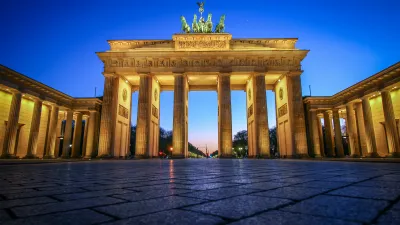
Berlin is Germany's capital, a city whose origins reach back more than 780 years. It became the capital of the kingdom of Prussia in 1701 and of the German Empire in 1871. Although Prussia was ruled by a gay king, Frederick II, from 1740 to 1786, the city's own gay story only began about a hundred years later. After World War II and the start of the Cold War it was split into West Berlin, held by the Western Allies, and East Berlin, held by the Soviet Union. In the 1920s, the so-called Golden Twenties, Berlin was regarded as having the liveliest and most advanced gay subculture in Europe. That ended in 1933 when the Nazis took power, and a memorial to gay people persecuted by the Nazi regime finally opened in 2008, more than 60 years later. During the division, West Berlin, an island within communist East Germany, became the gay capital of Germany again. Its population of around 3 million helped, and so did the fact that West Germany's compulsory military service did not apply to men there, which drew many young men to move in. After homosexual contacts were legalised in 1969, the scene and the gay movement grew fast through the 1970s and 1980s. In East Germany the legal situation for gay men was the best in the Eastern Bloc, and even better than in some Western countries. Yet in an authoritarian state, gays and lesbians could not organise a civil rights movement, and there were few chances to build a scene. Things improved toward the end of the 1980s, peaking with the premiere of the film Coming Out, ironically on the night the Berlin Wall fell in 1989. In 2001 Berlin elected an openly gay mayor, Klaus Wowereit of the Social Democrats, who outed himself at a party congress to pre-empt opponents with the words: 'Ich bin schwul, und das ist auch gut so' (I'm gay and that's just fine).
Cologne
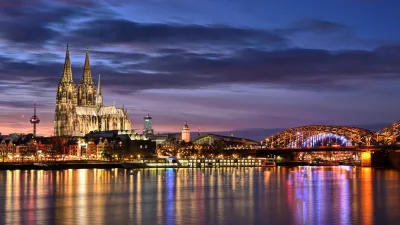
Cologne lies in western Germany, yet it is sometimes nicknamed the most southern city of Germany. Locals are known for being easy-going and approachable, and they love to borrow a Southern European lifestyle: as soon as a little sunshine appears, tables are set out in front of cafes and bars. The city was heavily destroyed in World War II, and the postwar drive to replace everything old with something new kept it from becoming one of Germany's most beautiful cities. For sightseeing there is not a huge amount besides the Cathedral, a UNESCO World Heritage site, plus a wide range of high-quality art galleries and museums and a few other attractions. What Cologne offers in return is a friendly, relaxed atmosphere. That atmosphere helped make Cologne the gay capital of western Germany. Compared with its big eastern rival Berlin, which is larger, more dynamic and more vibrant, the Cologne scene can seem a little provincial, but it is also more familiar and warmer. There are two major gay areas: around Rudolfplatz, many of the cafes, bars and clubs have a rather modern style, while traditional pubs and bars with a mixed-age crowd are found mainly in the Old Town. If you like your destinations packed, with a million people partying in the streets and pubs, the winter Carnival and the summer Cologne Gay Pride are made for you. Other popular annual queer events include Fetish Pride week in May or June and the Bear Pride weekend in November.
Frankfurt
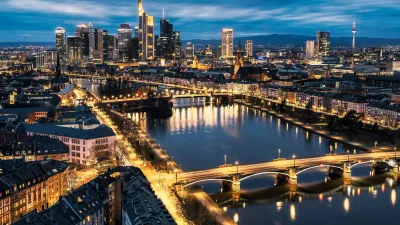
Frankfurt am Main is Germany's fifth-largest city, with more than 750,000 residents and over 2 million in the wider metropolitan area. Its history stretches back more than 1200 years, yet today it is known internationally above all as one of the world's leading financial centers. Sights include the historic city hall known as the Römer, the Kaiserdom St. Bartholomäus (the coronation church of Holy Roman emperors), the Goethe House in the Old Town and the Palmengarten botanical garden in the Westend. For many years most of Frankfurt's gay venues have clustered in the city center around Schäfergasse and Alte Gasse. The small square where the two streets meet has been named after the gay writer Klaus Mann since 1995. The queer calendar includes Frankfurt Gay Pride (CSD Frankfurt) in July, the Frankfurt Book Fair in October and the international LGBT sports tournament FVV Xmas in December. The city also has a darker chapter in its queer past: in the early 1950s the Frankfurt Homosexual Trials saw around a hundred gay men arrested, many of them prosecuted and sentenced and some driven to suicide, with at least one judge who had been zealous in persecuting homosexuals under the Nazis. In remembrance of Nazi persecution, the Frankfurter Engel (Angel of Frankfurt) memorial was unveiled on Klaus-Mann-Platz in 1994, the first monument of its kind in Germany.
Hamburg
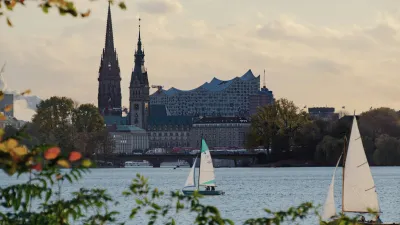
Hamburg, officially the Free and Hanseatic City of Hamburg, is Germany's "Gateway to the World" and its second largest city after Berlin, as well as a city-state in its own right. It lies on the river Elbe about 100 km southeast of the North Sea and has the country's largest seaport. Thanks to the harbor, the dammed Alster and countless canals and smaller rivers, it counts among the European cities with the most bridges. Settled since the Saxons and named after the Hammaburg castle of the 9th century, it grew through port rights and trade privileges into a medieval commercial hub and a Hanseatic League powerhouse, with Germany's first stock exchange (1558) and first opera house (1678). Fires, cholera, wartime bombing and floods have repeatedly reshaped it, and the newly built HafenCity district, home to the Elbphilharmonie concert hall, shows its constant renewal. Nearby, the neo-Gothic brick Speicherstadt, the world's largest warehouse complex built on oak piles, is well worth a visit, while the port draws crowds with the Sunday fish market, the harbor birthday in May and visiting cruise ships. Just around the corner in St. Pauli lies the famous Reeperbahn, Europe's largest red-light district. Hamburg's gay life is centered in the St. Georg district, especially in and around Lange Reihe, the main shopping street and promenade, lined with numerous gay-friendly cafés and boutiques. The queer calendar has two annual highlights: Hamburg Gay Pride (CSD) in early August and the queer film festival in October.
Munich
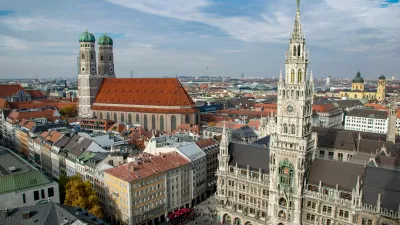
Munich is the capital of Bavaria and Germany's third-largest city, after Berlin and Hamburg. Nestled at the foot of the Alps, it combines stunning natural scenery with cosmopolitan wealth, making it a hub for media and tech industries. Throughout history it has drawn remarkable creative talent, from composers such as Gustav Mahler, Richard Strauss, and Richard Wagner to writers including Thomas Mann, Rainer Maria Rilke, and Bertolt Brecht, as well as the influential artist group Der Blaue Reiter, who helped establish Munich as a center of modern art in the early twentieth century. Despite Bavaria's reputation today as a conservative Catholic region, Munich has a surprisingly progressive past. Under King Maximilian I Joseph, Bavaria legalized consensual homosexual acts as early as 1813, though this liberal era ended with the formation of the German Empire in 1871 and the introduction of Paragraph 175. The city nonetheless claims a distinguished roster of gay figures, including the poet August Graf von Platen, Klaus Mann, filmmaker Rainer Werner Fassbinder, sex researcher Magnus Hirschfeld, and the beloved King Ludwig II, whose homosexuality was an open secret during his own lifetime. Today, gay life in Munich revolves around the Glockenbachviertel, a neighbourhood that transitioned from a red-light district in the 1970s to a haven for students, artists, and the LGBTQ+ community in the 1980s. Reichenbachstraße is home to the legendary Deutsche Eiche, a venue dating back to the 1950s and 60s that became notorious through its association with Fassbinder and his circle. At Sendlinger-Tor-Platz stands an AIDS Memorial designed by Wolfgang Tillmans, one of only a handful of such monuments in Germany. The vast English Garden, larger than New York's Central Park, offers both relaxation and a well-established cruising area along the Eisbach dating back to the nineteenth century. Key queer events throughout the year include the Stark-Bier-Fest in February or March, several street fairs from June through August, Munich Gay Pride in July, and the popular Gay Sunday at Oktoberfest in September.
Nuremberg
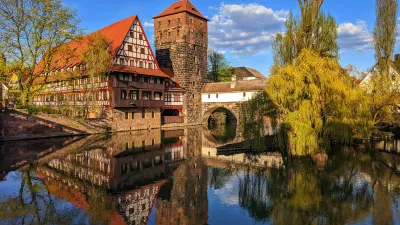
Nuremberg is Bavaria’s second-largest city and the heart of Franconia. Its medieval old town is surrounded by almost intact city walls and crowned by the mighty Imperial Castle. Wander the cobbled lanes past half-timbered houses, Gothic churches and the home of Albrecht Dürer, then browse the Germanisches Nationalmuseum, Germany’s largest museum of cultural history. The city also faces its 20th-century past head-on, at the Documentation Centre on the former Nazi Party Rally Grounds and the Memorium Nuremberg Trials in the historic Courtroom 600. Between visits, try the famous small grilled sausages, Nürnberger Rostbratwürste, with a local beer. In winter, the world-famous Christkindlesmarkt fills the Hauptmarkt with gingerbread and mulled wine. The gay scene is friendly, unpretentious and easy to explore on foot. Most of it sits in and around the Altstadt, with more venues in the up-and-coming Gostenhof district just to the west. Mardi Gras, right on the busy Königstraße shopping street, is the obvious meeting point and a good place to start the night. From there, cosy bars are scattered through the old town, including the long-standing Savoy Bar, and many of the city’s alternative bars are relaxed, queer-friendly places too. The highlight of the year is CSD Nürnberg Pride in late July and early August. Weeks of cultural events, parties and talks lead up to a big demonstration through the city centre, making it one of Bavaria’s major queer events. Germany has had marriage equality since 2017, and Nuremberg combines its rich history with a warm, open-minded atmosphere for gay travellers.
Stuttgart
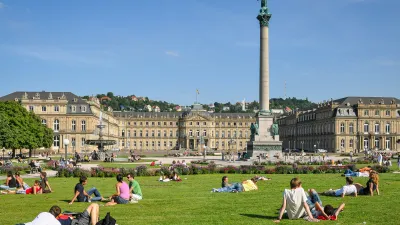
Stuttgart is the capital of Baden-Württemberg. It sits in a green valley surrounded by hills, forests and vineyards, some of which reach right into the city. It’s best known as the home of Mercedes-Benz and Porsche, and both brands’ museums are must-sees for anyone who loves design or cars. The centre is built around the elegant Schlossplatz, flanked by the New Palace and the busy Königstraße shopping street. Nearby, the Weissenhof Estate showcases Le Corbusier’s modernist houses, which are UNESCO-listed. Add the Wilhelma zoological and botanical gardens, the mineral springs of Bad Cannstatt, and the huge Cannstatter Volksfest every autumn. To eat, try Swabian classics like Maultaschen and Spätzle with a glass of local Trollinger wine. The gay scene is friendly and relaxed. Its heart is the historic Bohnenviertel and the neighbouring Leonhardsviertel in the old town, where small bars sit along cobbled lanes such as Leonhardstraße and Pfarrstraße. Tom’s Bar is a long-standing men’s bar here that stays busy into the small hours, and the other gay bars are only a few steps away. There are more venues and community spaces scattered across the city centre. The big event of the year is Stuttgart Pride in July. It’s the largest queer festival in Baden-Württemberg, with two weeks of cultural events leading up to the CSD parade through the city centre. The weekend ends with the CSD-Hocketse, a street festival with music, food and drinks on Marktplatz and Schillerplatz. Germany has had marriage equality since 2017, and Stuttgart is a safe and welcoming city for gay travellers.